This summer’s hot weather has prompted a number of clients to ask for advice on the best temperature at which to serve their wine. With ambient room temperatures feeling significantly different to other times of the year it’s a good question to ask and, as ever, we’re only too happy to help.
Imagine it this way: Does lemonade taste better at room temperature or ice-cold?
Most of us would agree that ice-cold brings out the full flavour of the lemonade leaving your tastebuds tingling in a way they don’t when presented with a warmer alternative. It’s the same with wine where attention to temperature can really enhance your enjoyment.
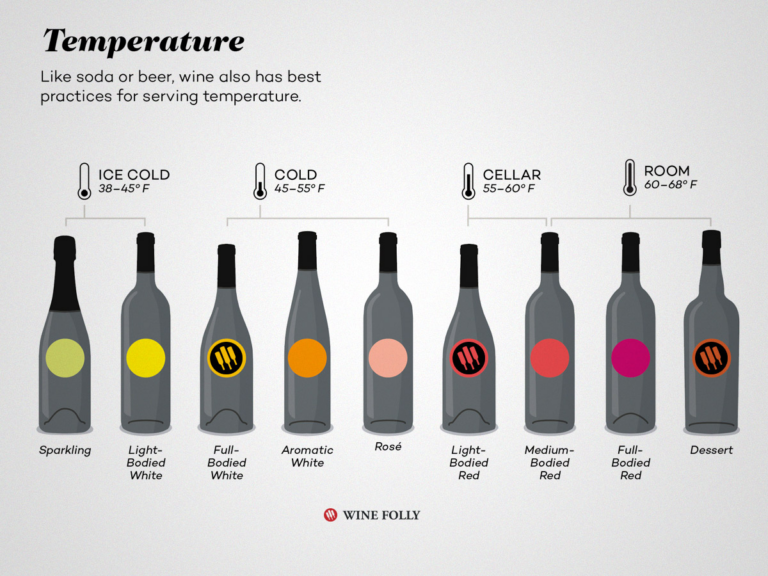
Here are some best practices on wine serving temperature based on style of wine.
Thank you to wine Folly for this handy illustration.
Keep it simple when testing the temperature of your wine. You can buy an inexpensive digital wine thermometer that wraps around a bottle. Or simply use a kitchen thermometer with a probe to test the outside of the bottle.
There more manual way is to apply the 20:20 rule. For room temperature red wine chill for 20 minutes before serving. Take white wine out of the fridge 20 minutes before pouring. Remember though, to keep those Champagne bubbles as cold as possible for as long as possible.
If the wine burns your nose with the smell of alcohol, it might be too warm so try cooling it down. If the wine doesn’t have any flavour, try warming it up as the fruit is too cold.
As with most things there are some caveats. If you’re given a lower quality wine don’t abandon all hope. It may do well served cooler as this mutes potential flaws in the aromas. The cooler a wine, the less aroma volatilizes in your glass.
If you’re lucky enough to drink higher quality vintage Champagne it’s important to allow it to warm up a bit to let out the aromas.
Wine serving temperature greatly affects what flavours and aromas of the wine you’ll smell. Personal preference also matters. If you like drinking everything ice cold, go for it, but check out what you might be missing at warmer temperatures first. Overall, wine tastes better served slightly cool.
Finally, if you want more advice on how to store and serve your wines, please remember that at R & J Fine Wines we pride ourselves on providing the personal touch. Just email Richard and the team with any questions you may have and they will be more than happy to help you out.