
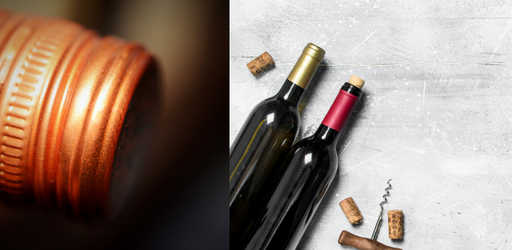
Is there anything more satisfying than the sound of a cork as it’s freed from the confines of its bottle?
Yet over the course of decades there has been a trend towards screw caps on wine bottles. Here we explore the age-old debate: cork or cap for your wine?
As with most things, history and tradition dictate people’s preferences for how their wine is enclosed. Many people say corks remain the best way to keep and age wine. Others argue that modern screw caps are easier to use and store their wine. Let’s take a look at the differences between the two.
Cork has been used to produce a wide variety of products for centuries. From clothes and shoes to flooring and building insulation, cork has had a place in manufacturing.
Yet, it was only in the 17th Century that it began being used to seal wine into a bottle. The porous nature of cork allows oxygen to gradually transfer into the wine helping develop more characteristics in the wine.
Cork comes from the bark of the cork oak tree (Quercus Suber). The process for creating corks begins with stripping the bark and drying it out over many months before cutting into a cork for usage. This method hasn’t changed much over time, although synthetic corks have been developed in recent years.
Combining the cork with a wire cage or wax melt proved to be the most effective way to seal and preserve wine.
Did you know?
Remember those films where the rugged hero would rip a cork out of a bottle with their teeth? Turns out this was historically correct as corkscrews weren’t invented for over 100 years after the cork. The corks would stand proud of the bottle neck so that they could be easily removed by hand (or teeth!).
Using caps to seal bottles isn’t a new technology and dates to as early as 1889. Dan Rylands of Barnsley patented the screw cap providing a convenient alternative to cork closures.
However, there were problems for many years with its use in wines and especially fine wines. When a French producer experimented with a screw cap in 1959 they discovered it didn’t stop wine ageing or oxidising. As you can guess, the screw cap was then abandoned for many years.
It wasn’t until the late 1970s that screw caps re appeared on bottles of wine. The Swiss wine industry developed a lining inside the screw cap, thus preventing oxygen getting into the wine and preserving the freshness.
In the 1980s the screw cap took hold of wine makers in the New World, with Australia leading the charge, and a whole new revolution began.
There are many benefits of using a wine cork. Environmentally they are far more sustainable plus, the forests the trees grow in sustain an ecosystem of animals, birds and plants.
Harvesting and manufacturing cork creates economic benefits, especially in Portugal and Spain who produce nearly 80% of the world’s cork supplies.
However, with cork usage reducing harvests are therefore diminishing affecting the environment and local economies.
In comparison, an aluminium screw cap provides convenience for the consumer but at a cost for the environment. From extracting the source material to refining the aluminium, huge amounts of water and electricity are used. Although the caps can be recycled, they often contain a plastic lining that needs to be removed for this process.
Cork? The classic traditional method. The cork is more flexible, it adapts to changes in temperature and pressure and is more sustainable and environmentally friendly.
Do you want to hear a pop or a fizz when you’re in a favourite restaurant and the sommelier is opening that once in a lifetime bottle?
Screw Cap? A modern alternative especially for New World wine producers who don’t distinguish between quality of wine and it’s enclosure. The screw cap provides an ease of use both in opening and closing plus, they are cheaper to make, making a bottle of wine more cost effective.
Perhaps its greatest benefit is storage. You don’t have to lay bottles on the side unlike wine bottles with corks as the cork will dry out if there is no liquid contact.
Perception can influence preference. The choice of closure does affect and influence our perception of quality with the cork and its history often associated with a premium product.
At R & J Fine Wines we pride ourselves on providing the personal touch. If you would like to find out more about Old World and New World wines we’re very happy to answer your questions.
Just email Richard and the team with any questions you may have and they will be more than happy to help you out.